
About the author
My name is François-Xavier Robin and I have been passionate about software development since I was a child.
Here is a brief chronological summary of my journey as a developer / sysadmin / architect …
1983-1984: The TV becomes interactive
Before my Atari 2600 arrived, the TV was just something I watched passively — Goldorak, Battle of the Planets, cartoons of the era.
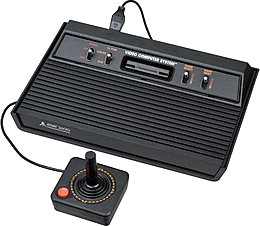
Games I had on it:
| Pole Position |
Snoopy and the Red Baron |
| E.T. (the famous one) |
Defender |
| Real Sport Tennis |
I still own this console and all its games to this day — after this, I moved exclusively to home computers.
1984-1989: Discovering home computing
In 1984, at age 9 (the mathematically gifted among you will have deduced my birth year via “subtraction”), I discovered programming thanks to a THOMSON TO7-70 sitting at the back of my primary school classroom. LOGO, BASIC 1.0, the light pen, the cartridges — it was a revelation. I asked the teacher to let me skip recess to spend time on the TO7 instead of playing marbles in the schoolyard.
At age 10, my parents gave me a THOMSON MO5: 48 KB of memory (32 KB RAM, 16 KB ROM), cassette storage, light pen. Alone with a few books on BASIC and assembly, it was a school of constant discovery — testing, crashing, resetting, and optimising. With 48 KB and 1 MHz, you had to be creative.
Even today, 30 years later, I still have that taste for optimisation and every well-used byte.
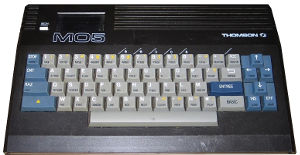
Among the small programs I wrote:
- A sort of chatbot — precursor but very limited, as you might imagine
- A membership management app for my father’s tennis club (with cassette storage)
- A game where TIE fighters fly across a targeting reticle and you destroy them
Unfortunately I no longer have any source code from that era.
You can also read about how to assemble a program for the MO5 from Linux.
At age 12, I upgraded — still Thomson — to a TO8: same 1 MHz clock, but 256 KB RAM, 80 KB ROM and a double-sided floppy drive. 360 KB per side! A flood of bytes. During this whole period my languages were BASIC 1.0, then BASIC 512 (both written by Microsoft), and 6809 assembly. The famous “Routines” …
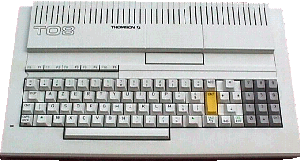
An excerpt from my article on the TO8 bootsector:
** PARAMETER EQUATES
START_SECTOR    EQU $02          ** first sector to read
NB_READ_SECTORS EQU $02          ** 2 sectors = 512 bytes
TARGET_ADDR     EQU $6300        ** load address

        ORG     $6200
        SETDP   $60

BEGIN
        LDA #$60
        TFR A,DP
        LDS #$A000

        LDX     #TARGET_ADDR
        STX     <REG_TARGET_ADDR
        LDA     #DISKOP_SECT_READ
        STA     <REG_DISKOP
        LDB     #START_SECTOR
        STB     <REG_SECTOR
        LDA     #NB_READ_SECTORS

!       JSR     DKCO
        BCS     END
        INC     <REG_TARGET_ADDR
        INC     <REG_SECTOR
        DECA
        BNE     <
        JSR     TARGET_ADDR

END     JMP [$FFFE]
On the TO8 I mostly refined the tennis club membership software, with random-access floppy storage (not sequential). It also generated mailing labels to print and stick on envelopes. Getting the print alignment right was a puzzle. Once again, the source code is long gone (sad).
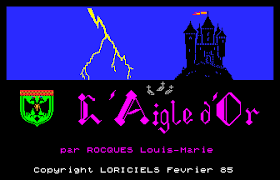
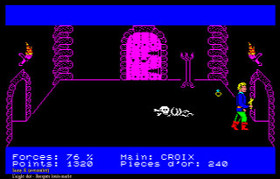
On these machines I still have a deep fondness for the game L’Aigle d’Or by Louis-Marie Rocques.
 |
 |
If you are not lucky enough to still own these wonderful working machines, check out Daniel Coulom’s excellent Thomson emulation site: http://dcmoto.free.fr
During the same period I also had great fun at my cousin’s and friends’ homes with ORIC ATMOS, AMSTRAD CPC 464 and 6128, and an MSX — fine company indeed.
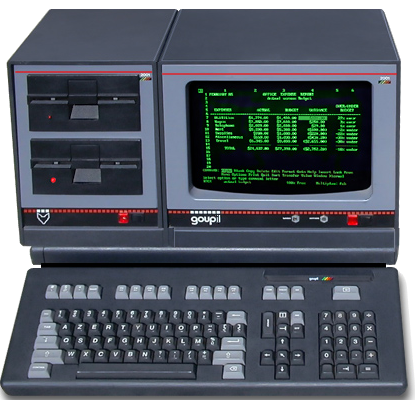
I also ran the computer club at my middle school: the technology teacher trusted me to manage the “GOUPIL” server that networked the MO5s (nanonetwork). M. Guintrand, if you’re reading this — thank you!
That was also the era when we “cracked” copy-protected software with POKE 8699,57. We had no idea what it actually did, but it worked… (note: disabling copy protection is wrong, kids).
1989-1993: A bit of acne, but a lot more RAM
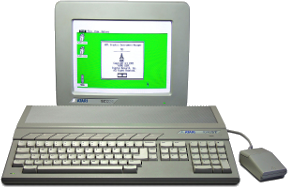
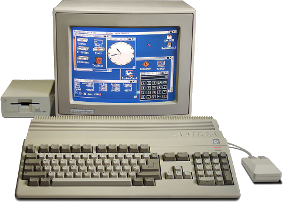
At 14 I moved into the 68000 world with an ATARI 1040 STE — 1 MB RAM, 8 MHz. Not a flood anymore, it was pure decadence. I also tinkered with a friend’s Amiga (Frédéric, if you’re reading this — thanks!) and we started coding in C (already!), Omikron, GFA Basic and STOS.
 |
 |
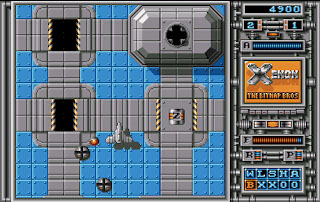
Thirty years later I still have an immense fondness for this machine, especially for the games XENON and XENON 2 by Bitmap Brothers.
 |
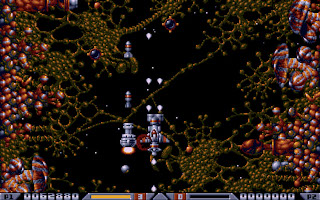 |
In 2017 I made a small tribute to those two games: Xenon Reborn, written in Java with LibGDX.
The GitHub project: https://github.com/fxrobin/Xenon_Reborn
An article about it: Developing while having fun and vice versa: Xenon-Reborn
1993-1996: A driving licence, a car, but mostly a 486 DX2 66 MHz Turbo
At 18, crash landing — I switched to a 486 DX2 66 (with a “turbo” button) and entered the world of x86, QBASIC and, still, assembly.
I went through university discovering many languages but staying loyal to C and assembly. With megabytes to spare and a 250 MB hard drive, “developing” had also become “my studies” — so my dear beloved-adored-mum could no longer tell me to “put down that computer and do your homework!”.
It was also when I discovered what an L2 cache was — the hard way. Every time I enabled it in the BIOS the PC ran noticeably better… until it crashed. Turned out my L2 cache was faulty.
I discovered Mode X (Mode 13h for the initiated), BIOS interrupts, graphics cards that crashed column resizing in Excel and WIN 3.11. The era of Watcom C++ and its famous dos4gw protected mode that every game used to access all the RAM — 16 MB!
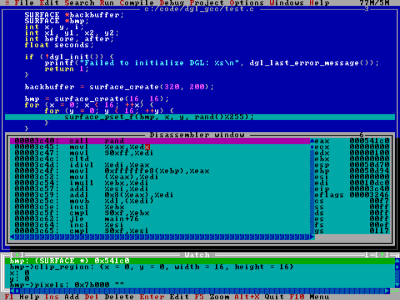
I wrote a game called “Red Devil 97”, a clone of “Blue Angel 69” from the Atari ST and Amiga.
Here is my still-BETA version — never finished, but it was playable both two-player and against the computer.
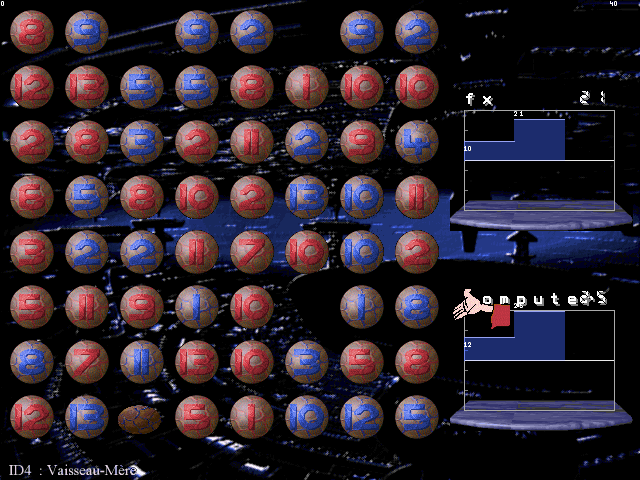
I still have the source code (C++ and Assembly), but it’s rough, so I won’t show it. This is where I wrote my first AI (a generous word for it) for the opponent player.
The game featured a full GUI with animations (60 FPS from memory), sprite animations, transparency effects, and an event manager. Some graphics routines were in assembly.
I integrated MIKMOD to play .mod and .xm files (Atari and Amiga tracker formats).
Maybe one day I’ll redo a clone of the clone in Java.
In C++ I also built a fact/consequence resolution engine called an “Expert System” with a fellow student (David Rideau, if you’re reading…). It was the Observer/Observable pattern — except we didn’t know that yet, we invented it ourselves. Changes propagated reactively: Reactive Programming before the name existed.
I entered an international algorithm competition to solve multi-constraint problems. We chose genetic algorithms, and I built the engine with my university tutor at Versailles-Saint-Quentin, Franck Quessette. It was magical and it worked well even for 1996.
I studied Pascal, COBOL, C++, ADA, and… in late 1996, JAVA! A revelation. Even though back then “Java is ugly”, “Java is slow”.
1996: My (love?) story with Java

Every question that hit me in 1996:
- What? I can finally have portable code without recompiling for each target?
- What? The JDK is free?
- What? I can build portable GUIs (it was AWT… ugh)?
- What? I can embed all this in Netscape (youngsters won’t understand)?
- What? When I update my app on the server it downloads automatically?
- What? It’s multithreaded?
Then in 1999:
- What? I can generate web pages server-side instead of CGI scripts (youngsters won’t understand) with Servlets?
- What? Tomcat is free?
- What? JBuilder is NOT free…
- What? I can connect to any database (yes, I also know SQL)?
Main Java projects between 1996 and 2002
- A SQL query interpreter / compiler
- A distributed RDBMS storage engine
- A web templating framework based on Servlets
- A Servlet-based XML templating and application framework (resembled JSF)
- A data extraction and integration tool with a pivot XML format
- An Apache VFS plugin to store files in a MySQL database
- An app to order drinks for colleagues (and myself) before heading to the bar
- A document management system with Lucene indexing and version control
To be continued
When I make the effort to remember everything else …


Contact me
Best via LinkedIn.